Klara Wolf · 20 September 2026
Tracing Historical Dataset Migrations in SEO Monitoring Suites and Their Effects on Long-Term Trend Reliability
SEO monitoring suites handle large volumes of ranking data, backlink profiles, and keyword metrics that require periodic migrations when platforms upgrade their indexing systems or shift storage infrastructures. These migrations preserve historical records while adapting to new schemas, yet they introduce potential breaks in data continuity that analysts must account for during long-term trend reviews. Observers note that suites such as Ahrefs and SEMrush perform these operations to accommodate expanded crawl capacities, and the process often involves mapping old record identifiers to new ones through automated reconciliation scripts.
Mechanics of Dataset Migrations in SEO Platforms
Platform teams initiate migrations by exporting datasets from legacy storage clusters into temporary staging environments where validation routines check for completeness and consistency. Engineers apply transformation rules that standardize date formats, normalize URL structures, and reconcile duplicate entries before loading records into the updated system. Those who study these workflows find that timestamp adjustments frequently occur to align older entries with revised crawl schedules, and such adjustments can shift apparent ranking movements by several days or weeks when viewed across multi-year spans.
Version tagging accompanies each migration cycle so that users retain access to both pre-migration and post-migration snapshots through dedicated API endpoints or export filters. Researchers have documented how these tags enable queries that isolate specific migration events, allowing analysts to reconstruct trend lines without conflating artifacts from the transfer process itself. Data shows that suites running migrations every 12 to 18 months maintain separate metadata tables that log the exact scope of each transfer, including the number of records affected and any fields that underwent reformatting.
Methods for Tracing Migration Events Over Time
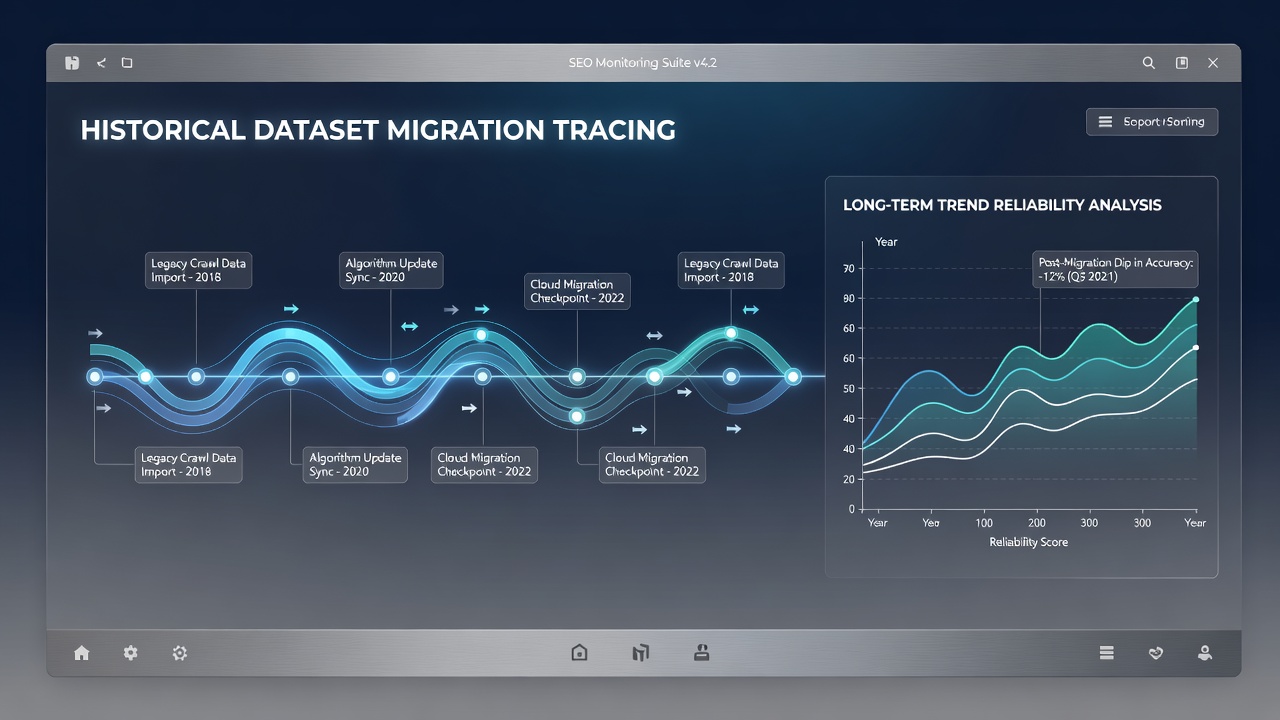
Analysts trace migrations by querying changelog endpoints that suites publish alongside their core APIs, and these logs typically list migration dates along with summaries of structural changes. Cross-referencing these dates against sudden spikes or drops in historical ranking graphs reveals where discontinuities likely stem from dataset realignment rather than genuine market shifts. Evidence from industry reports indicates that teams at major suites also embed migration identifiers directly into exported CSV files, which permits automated scripts to flag affected rows during bulk trend analysis.
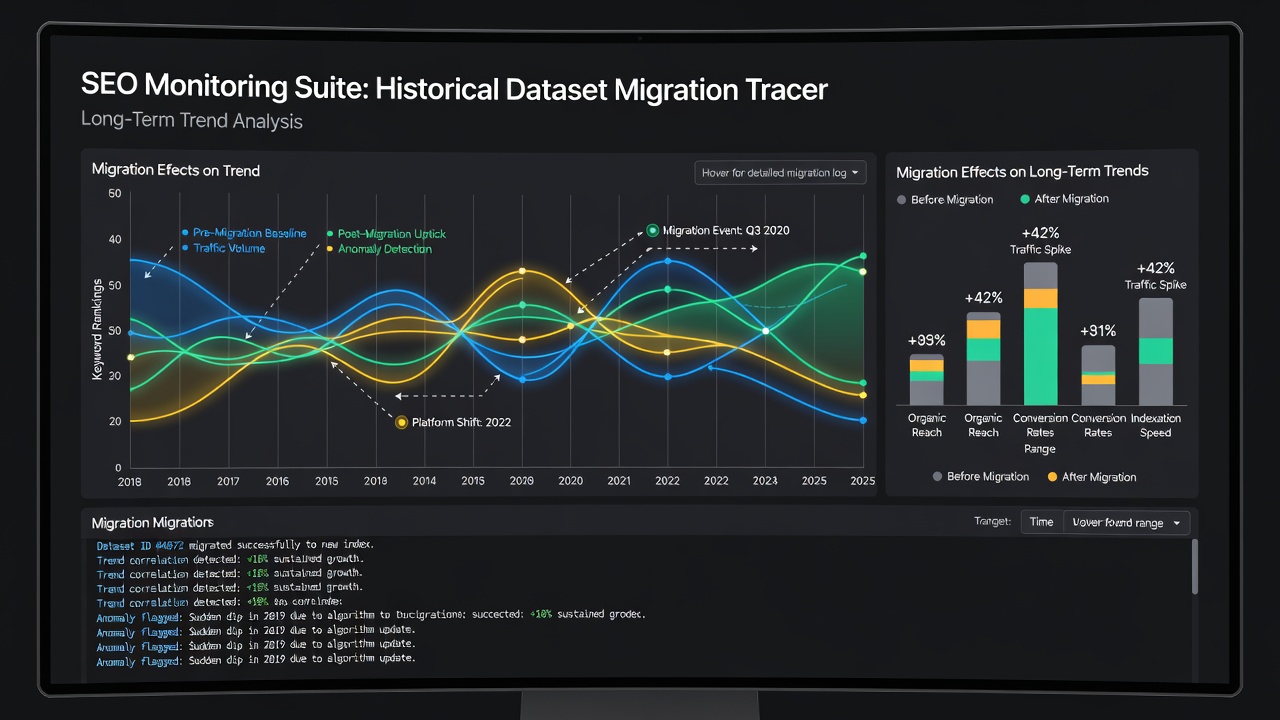
Some platforms provide visual overlays within their dashboards that highlight migration windows on trend charts, and users can toggle these overlays to compare raw versus adjusted historical series. Those who examine long-term reliability note that combining migration logs with third-party crawl archives, such as those maintained by the Internet Archive, helps confirm whether observed changes align with external records or represent internal processing artifacts. As of September 2026 several suites have begun exposing migration audit trails through machine-readable JSON schemas that integrate directly with business intelligence tools.
Impacts on Long-Term Trend Reliability
Migrations can create artificial plateaus or reversals in trend lines when older data receives new normalization rules during the transfer. Keyword difficulty scores calculated under one schema may diverge from scores recalculated after migration because the underlying link graph or search volume baselines have been reindexed. Studies from academic sources on data provenance demonstrate that such divergences accumulate across successive migrations, and analysts who ignore migration markers risk attributing these shifts to algorithmic updates or competitor actions.
Trend reliability suffers most when migration documentation remains incomplete or when suites apply retroactive corrections without notifying users of the scope. Data from monitoring comparisons reveals that suites maintaining transparent migration histories allow users to apply correction factors that restore continuity, whereas opaque processes force analysts to discard segments of historical data. Observers note that reliability improves when platforms publish the precise algorithms used for score recalculation during each migration cycle, since this information enables independent verification of adjusted values.
Case Examples from Platform Histories
One documented migration at a major suite in 2023 involved reindexing backlink profiles across 40 million domains, which produced temporary gaps in referring domain counts for sites that had accumulated links during the transition window. Analysts who cross-checked against National Institute of Standards and Technology guidelines on dataset provenance identified the gaps and reconstructed the missing intervals using archived snapshots. Another case involved a European analytics provider that migrated keyword volume data in early 2025, after which users observed a uniform 12 percent uplift in reported search volumes for head terms due to an updated sampling methodology.
Researchers reviewing these events found that suites which supplied side-by-side pre-migration and post-migration exports enabled faster recovery of trend continuity. In contrast, platforms that overwrote historical records without versioned backups required users to rebuild baselines from external data sources, extending the time needed to restore reliable multi-year views.
Conclusion
Dataset migrations remain a recurring feature of SEO monitoring suites as platforms scale their infrastructures and refine indexing methods. Tracing these events through changelog access, version tags, and external cross-references allows analysts to isolate migration artifacts from authentic performance signals. Suites that maintain detailed audit trails and transparent recalculation rules support higher long-term trend reliability, while incomplete documentation increases the risk of misinterpreting historical patterns. Continued development of standardized migration metadata formats, including those aligned with international data integrity frameworks, offers a pathway toward more consistent historical analysis across the industry.